

Toyota Highlander Hybrid vs. RAV4 Hybrid: Passenger and Cargo Space Compared
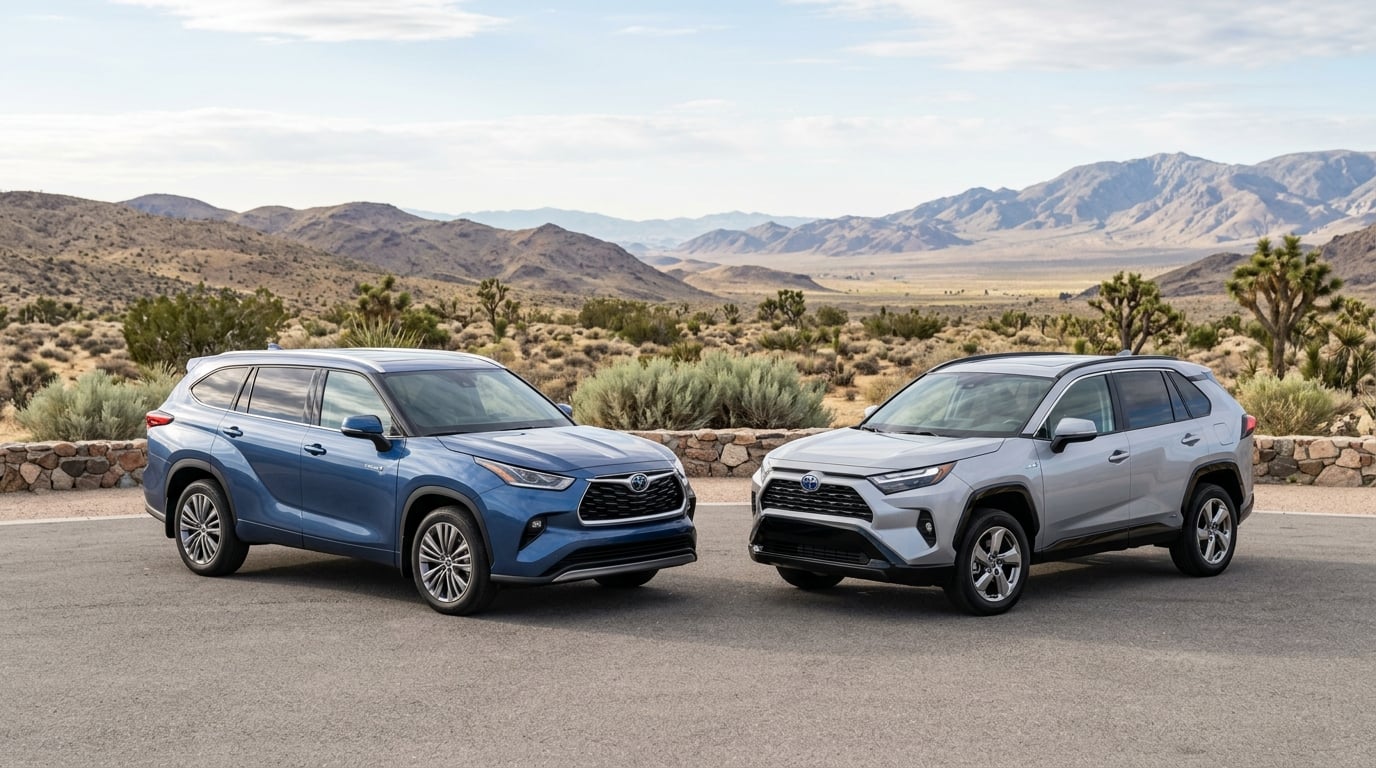
Toyota Highlander Hybrid vs. RAV4 Hybrid: Passenger and Cargo Space Compared
How the redesigned RAV4 Hybrid and the three-row Highlander Hybrid stack up on seating, cargo room, fuel economy, and towing for High Desert drivers.
If you’re cross-shopping Toyota’s hybrid SUVs, how many people and how much gear you need to haul is usually what decides it. Whether you’re commuting the I-15 corridor, hauling sports gear around Victorville, or loading up for a weekend in the San Bernardino Mountains, the choice between the three-row Highlander Hybrid and the two-row RAV4 Hybrid comes down to how you balance passenger seating against cargo room.
Short version: the midsize Highlander Hybrid seats 7 to 8 passengers across three rows, with roughly 140 cubic feet of passenger volume (it varies a bit by trim) and up to 84.3 cubic feet of cargo space behind the front seats. The compact RAV4 Hybrid seats 5 across 98.9 cubic feet of cabin volume, with up to 70.4 cubic feet of cargo space when the rear seats are folded. If you need seating for up to eight, a real third row, and more cargo room, the Highlander Hybrid is the better fit. If you want something easier to park daily and more fuel-efficient around town, the RAV4 Hybrid covers that instead.
Spec-by-Spec Comparison
- RAV4 Hybrid: 5 seats, easier to park daily
- Highlander Hybrid: 7-8 seats, real third row
- RAV4 Hybrid: up to 44 MPG combined
- Highlander Hybrid: up to 3,500 lbs. towing
| Specification | RAV4 Hybrid | Highlander Hybrid |
|---|---|---|
| Seating Capacity | 5 Passengers | 7 to 8 Passengers |
| Total Passenger Volume | 98.9 cu. ft. | ~140 cu. ft. (varies by trim) |
| Max Cargo (Seats Folded) | 70.4 cu. ft. | 84.3 cu. ft. |
| Cargo Behind 2nd Row | 37.8 cu. ft. | 48.4 cu. ft. |
| Cargo Behind 3rd Row | N/A | 16.0 cu. ft. |
| Front Legroom | 41.0 in. | 42.0 in. |
| Second-Row Legroom | 37.8 in. | 38.7 in. |
| Third-Row Legroom | N/A | 28.0 in. |
| Standard Drivetrain | Electronic On-Demand AWD | Electronic On-Demand AWD |
| Combined EPA Fuel Economy | Up to 44 MPG | 35 MPG |
| Max Towing Capacity | Up to 3,500 lbs.* | 3,500 lbs. |
*RAV4 Hybrid tows up to 1,750 lbs. on the LE trim, or up to 3,500 lbs. on XLE, Woodland, XSE, and Limited trims when properly equipped. Figures are manufacturer estimates and vary by trim and configuration; a Valley Hi Toyota product specialist can confirm exact specs for your build.
Comparing Cabin Dimensions: Front, Second, and Third-Row Room
On longer drives through the High Desert, front and rear legroom, headroom, and shoulder room make a real difference in comfort. Up front, both models offer more space than you’d expect. The Highlander Hybrid gives you 42.0 inches of front legroom, about 39.6 inches of headroom, and 59.0 inches of shoulder room, enough to keep most drivers comfortable through a long stretch down the Cajon Pass.
The compact RAV4 Hybrid holds up well here too, with 41.0 inches of front legroom, about 37.8 inches of headroom, and 57.0 inches of shoulder room. Despite the smaller footprint, taller drivers should still have room to stretch out.
The second row is where the two vehicles start to differ. The Highlander Hybrid offers 38.7 inches of legroom, about 39.4 inches of headroom, and 58.4 inches of shoulder room, and its second-row seats slide so passengers can trade legroom back and forth depending on whether the third row is in use. That third row adds 28.0 inches of legroom on top of that, useful for kids, teenagers, or extra passengers on family trips. The RAV4 Hybrid’s back seat comes in at 37.8 inches of legroom, about 39.5 inches of headroom, and 56.4 inches of shoulder room. It seats three across comfortably enough for a trip across town, but the Highlander Hybrid’s extra shoulder and hip room makes carrying three adults in the back noticeably easier.
Cargo Volume Breakdown: Behind the Seats and Maximum Storage
Knowing the actual cargo numbers helps when you’re deciding which hybrid fits your routine, whether that’s grocery runs, home improvement hauls, or a weekend in the mountains. Capacity changes quite a bit depending on how the seats are set up.
With all three rows up, the Highlander Hybrid gives you 16.0 cubic feet behind the third row, enough for groceries, backpacks, or a few small bags. Fold the 60/40 split third row down and that expands to 48.4 cubic feet behind the second row. Fold both rear rows flat and you’re at 84.3 cubic feet total.
The RAV4 Hybrid does well here too, offering 37.8 cubic feet behind the second row without folding anything down, enough for full-sized luggage, a double stroller, or camping gear. Fold the 60/40 rear seat and total cargo space opens up to 70.4 cubic feet, with a low load floor that makes loading easier.

Both vehicles fold flat, come with tie-down cargo hooks, and offer a hands-free power liftgate, so loading up is easy whether you’re hauling warehouse club purchases or mountain bikes.
Seating Capacity & Family Usability
RAV4 Hybrid Usability
The 5-passenger RAV4 Hybrid keeps things simple for daily driving. It works well for solo commuters, couples, or small families, and the second row easily fits two child safety seats using standard LATCH anchors, with doors that open wide enough for easy access.
Highlander Hybrid Flexibility
The Highlander Hybrid is built for growing families. Standard 8-passenger trims use second and third-row 60/40 bench seating. Trims with second-row captain’s chairs seat 7 instead, trading the middle seat for a center walkway and more elbow room.
Grand Highlander Alternative
Need even more room? The Toyota Grand Highlander Hybrid offers an adult-sized third row with 33.5 inches of legroom and up to 97.5 cubic feet of total cargo space. You can compare the full lineup on our new vehicle inventory page.
Fuel Economy: Which One Gets Better MPG?
For anyone driving I-15 toward San Bernardino or Riverside regularly, fuel efficiency adds up fast. Toyota’s hybrid system means going with an SUV doesn’t mean giving up good gas mileage.
The RAV4 Hybrid comes out ahead on efficiency, rated up to 48 MPG City / 42 MPG Highway / 44 MPG Combined on the FWD LE trim (46/40/44 on AWD LE). Exact numbers shift a bit by trim, but it’s a strong highway cruiser either way.
Even with a much bigger three-row footprint, the Highlander Hybrid still posts a solid EPA-estimated 35 MPG City / 34 MPG Highway / 35 MPG Combined. Compared to a traditional V6 three-row SUV, which often averages under 22 MPG combined, that difference can mean real savings at the pump over time.
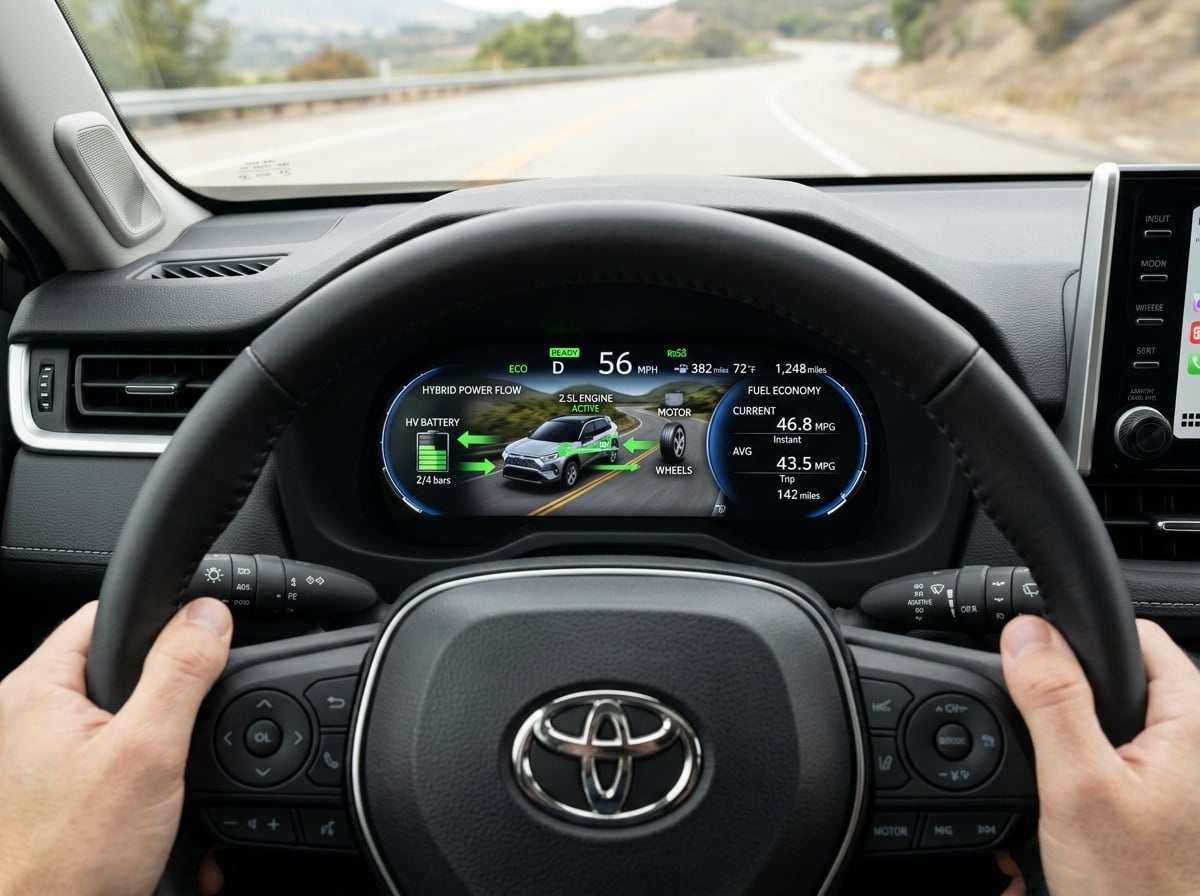
Both hybrid systems blend the gas engine with electric motor torque and recapture energy through regenerative braking on downhill mountain stretches.
Power and Towing Through the Cajon Pass
One question High Desert buyers ask a lot: how do these hybrids handle a steep grade like the Cajon Pass on I-15? Climbing under summer heat or a winter headwind takes real torque, not just horsepower on paper.
The RAV4 Hybrid puts out up to 236 combined system horsepower on AWD trims (226 hp on FWD). The electric motor delivers instant torque, so you get quick throttle response climbing a grade or passing slower traffic, and the CVT keeps the engine in its sweet spot instead of hunting through gears.
The Highlander Hybrid steps up to 243 combined system horsepower. It’s tuned to carry up to eight passengers and a full load of cargo up a steep grade without feeling like it’s working too hard. Loaded down with family and luggage, its extra horsepower and quieter cabin make for a more relaxed climb over a mountain pass, whatever you’re carrying.
Electronic All-Wheel Drive Is Standard on Both
Both the RAV4 Hybrid and Highlander Hybrid come standard with Toyota’s Electronic On-Demand All-Wheel Drive. There’s no mechanical driveshaft connecting the front and rear axles like you’d find on older AWD systems. Instead, a dedicated rear electric motor kicks in the moment it detects wheel slip, delivering quick traction on sandy desert roads, wet pavement, or a surprise snow squall on a trip up to Wrightwood. Because the rear motor only engages when it’s needed, both SUVs get better all-weather stability and light off-road traction without the fuel economy hit of a traditional 4WD transfer case.
Towing Capacity and Payload for Weekend Gear
High Desert weekends often mean towing toys, trailers, or a boat. Towing capacity is another real difference between these two hybrids.
The Highlander Hybrid tows up to 3,500 lbs. when properly equipped, enough for a small travel trailer, a pop-up camper, a utility trailer, or personal watercraft heading to Lake Havasu or up into the mountains.
The RAV4 Hybrid tows up to 1,750 lbs. on the LE trim, or up to 3,500 lbs. on XLE, Woodland, XSE, and Limited trims when properly equipped, plenty for a lightweight utility trailer, a small teardrop camper, or a hitch-mounted bike rack.
To add gear-carrying capability to either model, visit our parts center or order parts online, including genuine Toyota roof rack crossbars, tow hitches, and cargo liners.
Cabin Amenities and Technology for Long Drives
Audio & Connectivity
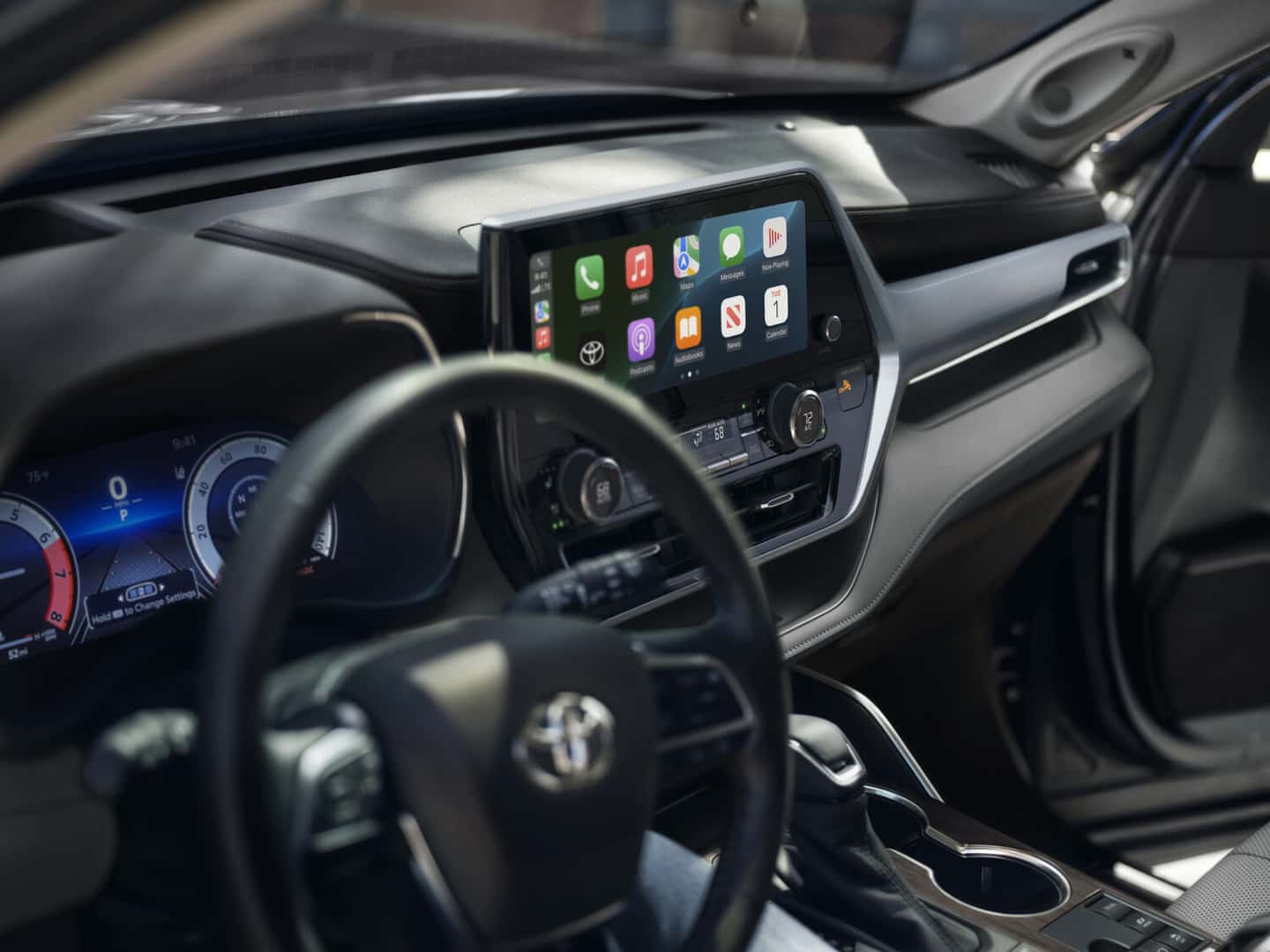
Both hybrid SUVs come with Toyota Audio Multimedia, wireless Apple CarPlay, and Android Auto. Touchscreens range from 8 inches up to a 12.3-inch display with cloud navigation, depending on trim.
Climate Comfort
High Desert summers put real demands on air conditioning. The Highlander Hybrid comes with standard three-zone automatic climate control and rear vents, while the RAV4 Hybrid offers dual-zone automatic climate control.
Power & Storage
Multiple USB charge ports across both rows keep everyone’s devices charged. Available SofTex-trimmed seating, heated and ventilated front seats, and a panoramic glass moonroof are there for longer trips.
Thinking About a Trade-In?
If you’re upgrading to a RAV4 Hybrid or Highlander Hybrid, you can get a free trade-in valuation for your current vehicle online before you even come in, so you know roughly where you stand going into the conversation.
Long-Term Hybrid Battery Reliability and Desert Service Care
Toyota’s hybrid systems have a strong reliability track record. Every new Toyota hybrid comes with a 10-year / 150,000-mile Hybrid Battery Warranty (whichever comes first), which matters if you plan to keep the vehicle a long time.
High Desert conditions, summer heat and airborne dust especially, mean maintenance still matters. Routine hybrid battery cooling filter inspections, engine air filter replacements, and inverter coolant checks help keep the system running the way it should year after year.
Our factory-certified technicians at Valley Hi Toyota use genuine OEM parts and diagnostic equipment built specifically for Toyota hybrid systems. You can schedule service online whenever it’s convenient.
Highlander Hybrid vs. RAV4 Hybrid FAQ
Which Toyota hybrid SUV has more cargo space?
The Highlander Hybrid has more maximum cargo space, up to 84.3 cubic feet with the rear seats folded, compared to up to 70.4 cubic feet in the RAV4 Hybrid.
How many people can the Highlander Hybrid seat?
The Highlander Hybrid seats 7 to 8 passengers across three rows, depending on whether the trim has second-row captain’s chairs or a 60/40 bench. The RAV4 Hybrid seats 5.
Do both the RAV4 Hybrid and Highlander Hybrid come with all-wheel drive?
Yes. Both come standard with Toyota’s Electronic On-Demand All-Wheel Drive, which uses a rear electric motor instead of a mechanical driveshaft.
How much can each of these hybrids tow?
The Highlander Hybrid tows up to 3,500 lbs. when properly equipped. The RAV4 Hybrid tows up to 1,750 lbs. on the LE trim, or up to 3,500 lbs. on XLE, Woodland, XSE, and Limited trims.
Which gets better gas mileage, the RAV4 Hybrid or Highlander Hybrid?
The RAV4 Hybrid is more fuel-efficient, rated up to 44 MPG combined on FWD LE trims, compared to 35 MPG combined for the Highlander Hybrid.
Test Drive the Highlander Hybrid or RAV4 Hybrid at Valley Hi Toyota
Still deciding between the agile RAV4 Hybrid and the spacious three-row Highlander Hybrid? The easiest way to decide is to see both side by side in person at our Victorville showroom.
Valley Hi Toyota · 14612 Valley Center Dr, Victorville, CA 92395 · Get Directions · (866) 632-6290
0 comment(s) so far on Toyota Highlander Hybrid vs. RAV4 Hybrid: Passenger and Cargo Space Compared